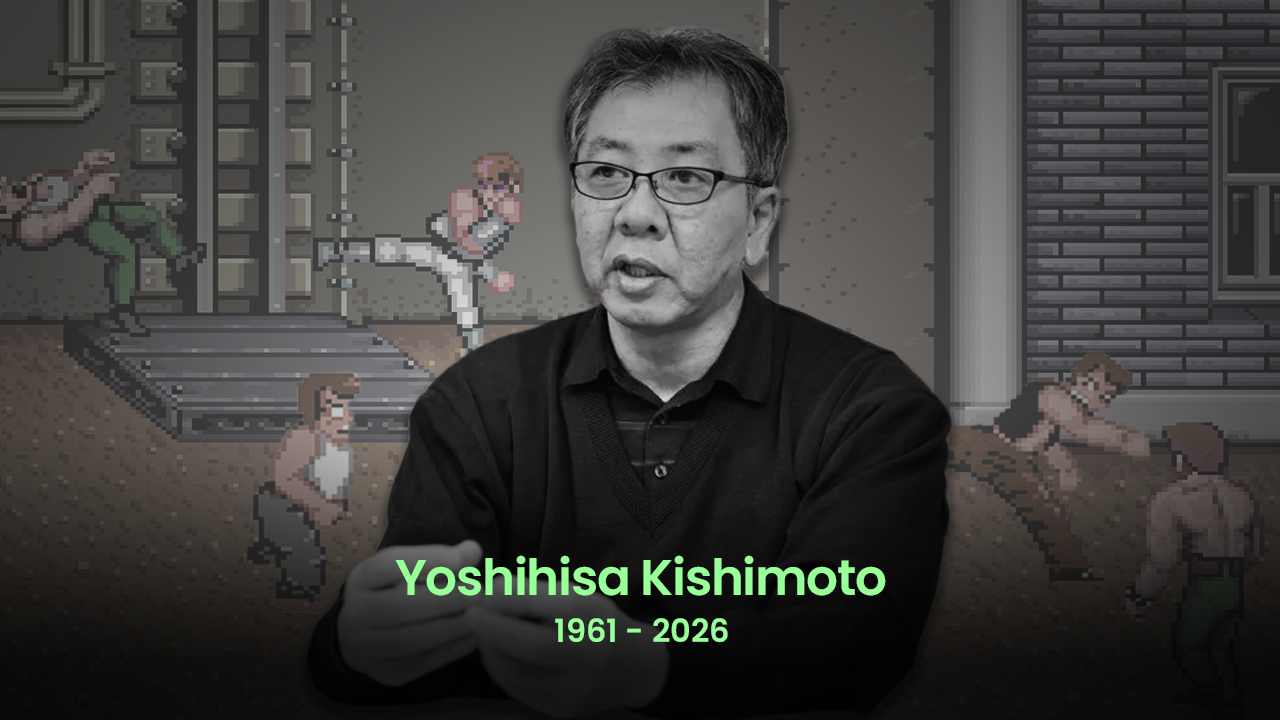
I hesitated before writing about the passing of Yoshihisa Kishimoto, one of the key figures behind beat ’em ups and a pioneer of the genre. Not long ago, I also wrote about Hideki Sato after his death, and I don’t want to only reflect on these great figures when they are gone.
Still, I felt it was important to write this tribute. We are talking about a Japanese game designer who helped define an entire genre, yet, like many others, he never received the same level of recognition as names such as Hideo Kojima, Shigeru Miyamoto, or Yu Suzuki.
On April 2nd, Yoshihisa Kishimoto passed away at the age of 64. The news was shared by his son, Ryubo Kishimoto, in a Facebook post on April 6th. Few details have been made public about the circumstances.
Kishimoto began his career at Data East, working on laserdisc arcade games such as Road Blaster (also known as Road Avenger or Road Prosecutor) and Cobra Command (Thunder Storm). These titles later became popular in the East when ported to platforms like the Sega CD, and eventually reached consoles such as the PlayStation and Sega Saturn. However, it was not there that he truly found his creative voice.
After leaving Data East, Kishimoto joined Technos Japan, where he finally had the freedom to create the kinds of games he wanted.
Yoshihisa Kishimoto and the Birth of Beat ’em Ups
A big fan of Hong Kong martial arts films, especially Bruce Lee’s Enter the Dragon, and someone who openly admitted to getting into frequent fights during his youth, Kishimoto brought that raw energy into game development. He led the creation of Nekketsu Kōha Kunio-kun in 1986, known in the West as Renegade, and followed it with Double Dragon in 1987.
It’s hard to imagine what games like Final Fight (Capcom, 1989), Streets of Rage (SEGA, 1991), or Teenage Mutant Ninja Turtles: The Arcade Game (Konami, 1989) would have been without these titles and the Kishimoto’s impact on beat ’em u.
Renegade introduced the foundation of what became known as “belt-scrolling,” allowing players to move not only left and right but also up and down, creating a sense of depth. Less than a year later, Double Dragon pushed the genre even further by introducing cooperative gameplay for two players. With that, the golden age of beat ’em ups was born, dominating arcades from the late 1980s to the mid-1990s.
This era gave us classics like Golden Axe (SEGA, 1989), The King of Dragons (Capcom, 1991), and The Simpsons Arcade Game (Konami, 1991). While the genre cooled off for a time, it has recently seen a resurgence with titles such as Streets of Rage 4 (2020), River City Girls 2 (2022), Absolum (2025), and Marvel Cosmic Invasion (2025), proving that the influence of Yoshihisa Kishimoto’s work is still alive today.
Technos Japan closed its doors in 1996, with Double Dragon and Kunio-kun standing as its defining legacies, even shaping the company’s final logo starring Kunio himself. Kishimoto remained with the company until the mid-1990s and worked on titles such as Double Dragon II: The Revenge, Double Dragon III: The Sacred Stones, and their console versions, as well as Super Double Dragon (1992).
He also contributed to the River City (Kunio-kun) series, including Super Dodge Ball (1987) and Shodai Nekketsu Kōha Kunio-kun (1992). In later years, he served as director on Double Dragon IV (2017) and contributed as a consultant on projects like Double Dragon Neon (2012) and River City Ransom: Underground (2014).
My Personal Connection to His Games
I don’t think I ever worked directly with any of his games, but I have very clear memories of playing Double Dragon in arcades, as well as its sequels. As a big fan of the genre, I always find a way to revisit these classics and relive that nostalgic feeling.
Less than six months ago, during the start of the harsh Canadian winter, I replayed the entire trilogy from start to finish.
It’s always important to look at great games and understand where they came from. Playing a modern beat ’em up naturally leads back to Double Dragon, just like playing a great FPS reminds you of Doom, or a racing game like Horizon Chase 2 brings OutRun to mind.
Unfortunately, Double Dragon hasn’t been in its best phase under Arc System Works, the holder of the rights to Technos Japan games. Titles like Double Dragon Gaiden: Rise of the Dragons and Double Dragon Revive feel underwhelming and fail to capture the essence of the originals.
On the other hand, the River City series is doing much better. River City Girls 2 is excellent, even if River City Saga: Three Kingdoms Next doesn’t fully capture the series’ charm. Overall, when WayForward is involved, the results tend to be much stronger.
Another legend is gone.
Thank you for everything, Yoshihisa Kishimoto. Your legacy in beat ’em ups continues to inspire developers and bring joy to players around the world.
If you enjoy retro-inspired games and their history, you might also like some of my other articles exploring how classic design continues to shape modern titles. And if you enjoyed this text, send me a message and I’ll be happy to continue the conversation.

About Spencer Stachi
Spencer Stachi is a communications professional and video game specialist based in Montréal, Canada. With a background in PR, social media, and the gaming industry, he has worked with international publishers including Atari, Electronic Arts, and WB Games. He is also a Certified Accessible Player Experience Practitioner and a Safe in Our World Ambassador, advocating for accessibility and mental health in games and the gaming industry.