The Rise, Legacy, and Decline of a Tactical Gaming Giant
One question I often ask myself is: is being acquired by a large company actually a good thing for a game studio?
Looking at what has been happening in the industry lately, especially with companies like Electronic Arts, the answer doesn’t always seem positive. But at the same time, people inside the industry often say the opposite. Securing investment for a game is incredibly difficult, and without it, many studios simply wouldn’t survive.
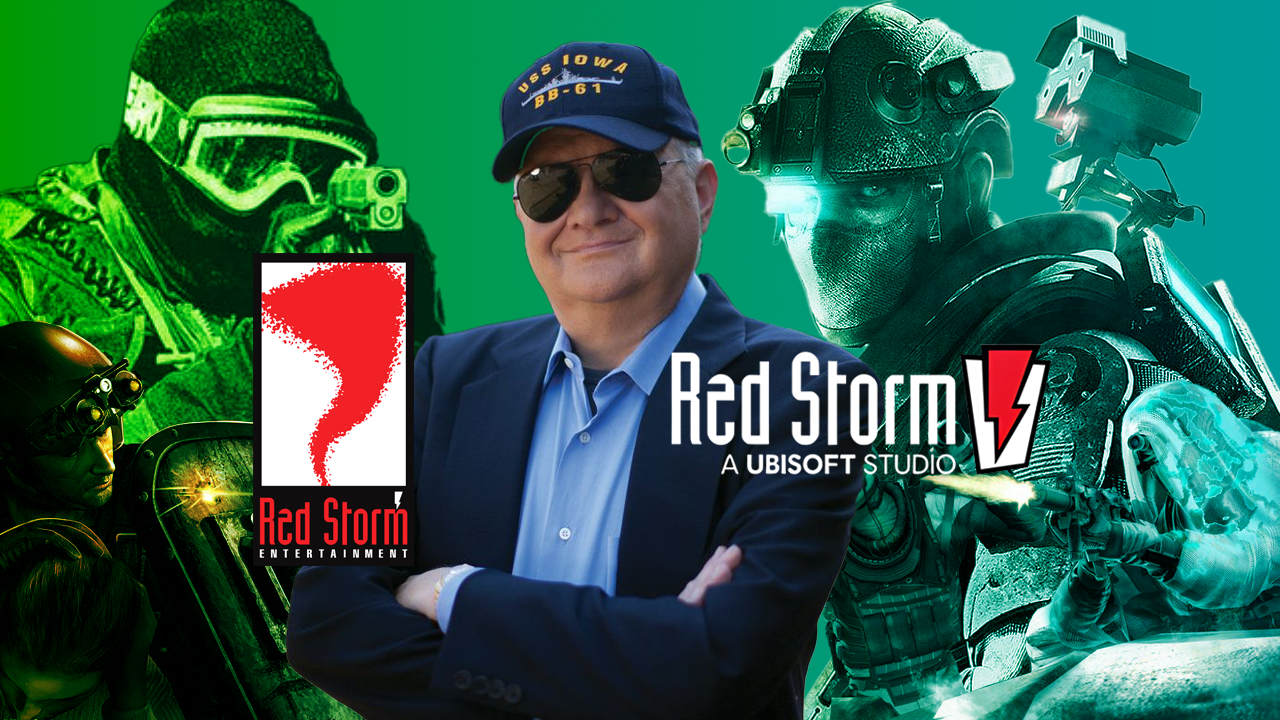
At the time of writing, Red Storm Entertainment has not officially been shut down. However, reports indicate that around 100 employees have been laid off, and Ubisoft has confirmed that no new games will be developed at the studio.
So what happens next?
Does Red Storm become just another support studio, or is this effectively the end of one of the most important names in tactical gaming?
Who Is Red Storm and Tom Clancy?
Red Storm Entertainment was founded in 1996 by Tom Clancy, a writer whose military and political thrillers became a global phenomenon. His work inspired films such as The Hunt for Red October, Patriot Games, Clear and Present Danger, and The Sum of All Fears, as well as the series Tom Clancy’s Jack Ryan.
At the center of many of these stories is Jack Ryan, a character Clancy created before he became famous, when he was still working as an insurance agent. Ryan evolves from a former U.S. Marine into a CIA analyst and eventually President of the United States, forming the backbone of what fans call the Ryanverse.
I have only read two of Clancy’s books, Rainbow Six and The Sum of All Fears, but both left a strong impression on me. Rainbow Six in particular is closely tied to my love for the original games (and not Siege). And The Sum of All Fears, combined with the impact of the movie on me, plus the recent release of the book in Brazil (shortly after the movie), and the game that came out in 2002, which was very similar to Rainbow Six. It is also where John Clark emerges as a key figure, known by players as the tactical leader of the Rainbow Six team.
Red Storm and Its Greatest Creation: Rainbow Six
Shortly after Clancy’s involvement in the submarine simulation SSN, Red Storm was officially formed. In its early years, the studio released a few lesser-known titles, but everything changed in 1998 with Tom Clancy’s Rainbow Six.
This was the turning point.
Released alongside the novel, the game introduced a level of tactical depth that was rare at the time. Unlike traditional shooters, Rainbow Six was built around planning rather than reflexes. Before each mission, players could analyze maps, position squads, and define entry points such as doors and windows. Once the mission began, success depended on coordination and execution, often requiring players to control multiple teams and time their actions carefully.
This design philosophy led to one of the most iconic concepts in shooter games: one shot, one kill. The idea that a single mistake could end a mission reinforced the importance of strategy over action.
The sequel, Tom Clancy’s Rainbow Six: Rogue Spear (1999), refined this formula with improved level design and larger environments. However, a major shift occurred in 2000, when Ubisoft acquired Red Storm.
From that point on, the identity of the series began to evolve. Titles like Rainbow Six 3: Raven Shield (2003) maintained the tactical depth on PC, while console versions became more action-oriented. Later entries such as Rainbow Six: Lockdown (2005 on consoles and 2006 on PC) continued to move in that direction.
Eventually, Red Storm stepped away from the franchise entirely. Ubisoft carried it forward with games like Rainbow Six: Vegas (2006) and Rainbow Six: Vegas 2 (2008). These were strong titles, but clearly different from what the series originally represented. And Siege… well, I think you already know how I feel about that.
The Next Chapter: Ghost Recon
After the acquisition, Red Storm launched Tom Clancy’s Ghost Recon (2001), marking a significant shift in design philosophy.
Instead of confined indoor environments, Ghost Recon introduced large open maps with forests, fields, and military installations. This change expanded the tactical possibilities and helped define the genre in a new way. Players could command multiple squads, each with distinct roles, reinforcing the importance of coordination and positioning. Ghost Recon has always been seen as an example in the market, as something that defined and refined the tactical shooter genre.
The series continued to evolve over the years. Ghost Recon 2 (2004) brought different versions depending on the platform, with varying levels of quality and design. The Advanced Warfighter (the first in 2006 and the second in 2007) titles introduced new mechanics such as third-person perspective on consoles and the Cross-Com system, which enhanced situational awareness and squad control.
By the time Ghost Recon: Future Soldier (2012) was released, the series had become more accessible, simplifying many of its tactical elements in favor of a broader audience.
Later entries like Ghost Recon Wildlands (2017) and Ghost Recon Breakpoint (2019) continued this trend. While Wildlands was well received, Breakpoint struggled at launch, highlighting the challenges of balancing accessibility with depth. Even so, the series maintained a strong identity, even if it no longer reflected its original roots.
The Last One Turns Off the Lights
After Future Soldier, Red Storm was no longer leading major tactical projects. Instead, the studio shifted toward different types of experiences, including virtual reality titles such as Werewolves Within and Star Trek: Bridge Crew, as well as Assassin’s Creed Nexus VR.
Although these games were well received, they felt disconnected from what originally defined the studio. At the same time, several projects were cancelled, including a Splinter Cell VR title and The Division Heartland, which was intended to expand the universe introduced in 2016.
Final Thoughts
In an industry that feels increasingly volatile, seeing a studio like Red Storm gradually lose its identity leaves a bitter impression, and “perhaps” it’s not its fault?
It raises an important question about the role of large publishers. When smaller studios are acquired, what is the long-term vision? Too often, it feels like talent is absorbed, identity is diluted, and eventually forgotten.
Red Storm helped define tactical shooters and built franchises that still exist today. Ironically, its legacy lives on through those same franchises, even as the studio itself fades into the background.
I hope you enjoyed this article and, if you haven’t already, that you take the time to experience the classics that defined this era. And you can write to me if you want to continue this conversation.
If you’d like to learn more about the industry and similar topics, feel free to explore my other articles, where I talk about modern games that capture the feeling of retro classics, as well as my thoughts on recent releases like Marathon.

About Spencer Stachi
Spencer Stachi is a communications professional and video game specialist based in Montréal, Canada. With a background in PR, social media, and the gaming industry, he has worked with international publishers including Atari, Electronic Arts, and WB Games. He is also a Certified Accessible Player Experience Practitioner and a Safe in Our World Ambassador, advocating for accessibility and mental health in games and the gaming industry.